
Apartment access: test the whole route from street to front door
Check the complete route into a prospective home, including thresholds, lift access and turning space. A practical visit with a pushchair or mobility aid.
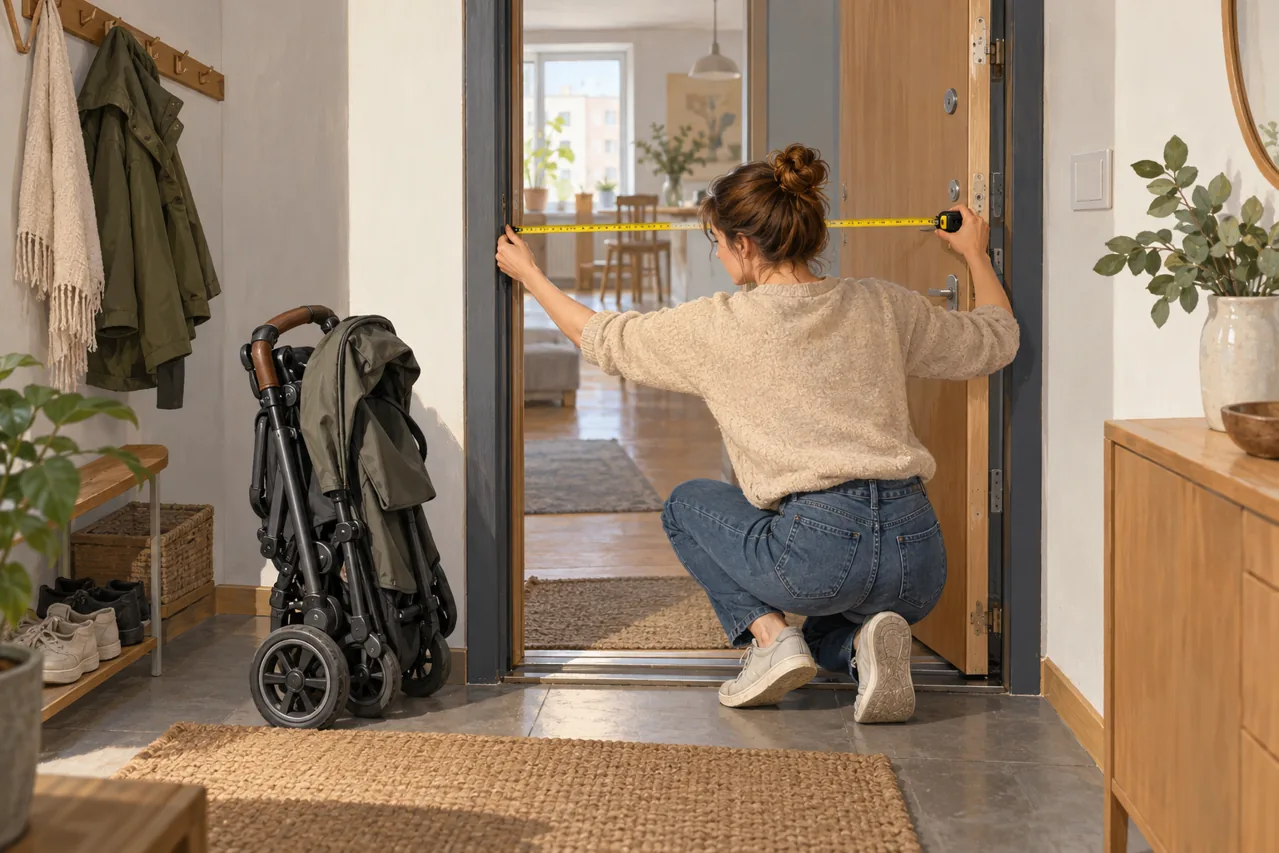
“Lift available” in a listing does not describe the whole journey into an apartment. Steps may come before the lift, an entrance door may close awkwardly, or a pushchair may struggle with a corridor turn. If a home will be used with a pushchair, wheelchair or another mobility aid, arrange a visit focused on access. A wet November day can also reveal details missing from sunny listing photographs.
Bring the dimensions that matter
Measure the equipment in its normal travelling position. A folded pushchair measurement is of limited use if arriving home usually involves a child and shopping bags. Where possible, bring the actual equipment, agreeing this with the seller beforehand.
Write down one central question: can I get inside independently with my usual load? This is more useful than deciding that an entrance “looks spacious”. The exercise assesses your own practical needs; it is not a professional audit of the building’s compliance with accessibility requirements.
Follow the complete route
Start where you would genuinely arrive: the pavement, parking space or approach from public transport. Note slopes, steps and places where water collects. Ask how snow clearance and slippery surfaces are managed at this particular entrance. A maintenance arrangement is not a promise that the route is unobstructed at every moment.
At the entrance, try opening the door while moving through it. Can you reach the handle? Does the door close before you clear it? Is there space to open the next door in the lobby? Measure the usable clear opening, rather than relying on the nominal size of the door leaf.
Check both ends of the lift journey
Establish whether the lift can be reached without stairs and whether it stops on the apartment’s actual level. With permission, test entry, positioning and exit safely and without rushing. A large cabin does not solve a tight turn immediately outside its doors.
At the apartment, check the threshold, the door’s swing and the space needed to handle keys. If another person’s assistance is necessary, record that plainly. “We can probably manage somehow” is different from a workable daily journey.
Separate present conditions from proposed changes
Make two columns: works now / needs alteration. If a ramp or automatic door is mentioned, ask who decides on the change and what has already been agreed. Do not count a proposed improvement as an existing feature.
Tallinn’s LIPS system provides information about public places and movement routes, but it cannot replace inspecting a particular apartment building. Save measurements, photographs taken with permission and unanswered questions. This lets you compare homes by the route you will actually use, rather than by the same reassuring word in both listings.
Sources
Prepared 1 November 2026. The image is an AI-generated illustration.