
Choosing a cat scratcher: start with place and surface
Observe where and how your cat scratches before choosing a post or pad. A practical way to assess position, stability and the surface your cat uses.
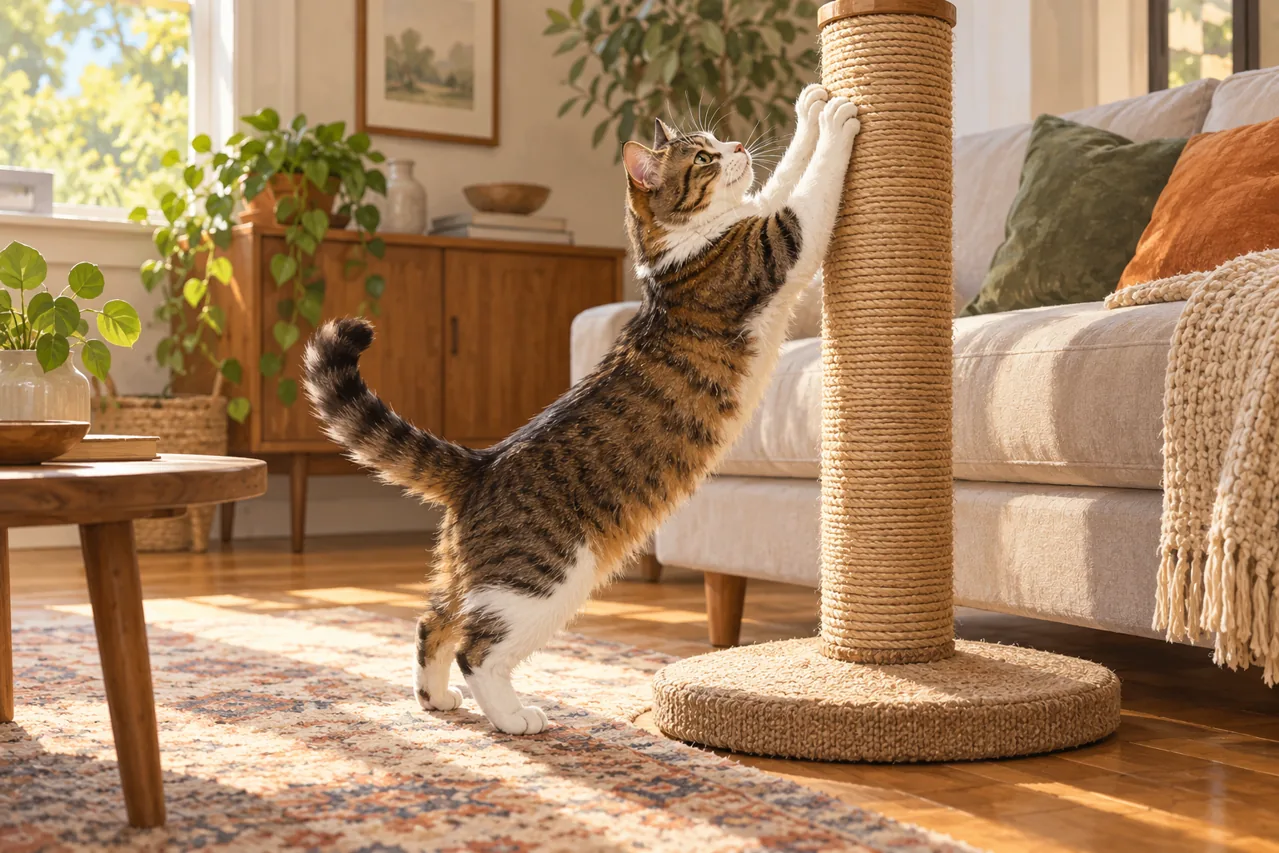
An untouched new scratching post does not automatically mean your cat has no interest in scratching. The position, surface or working posture may not suit its habits. November evenings at home offer a useful opportunity to observe what actually happens. Start with a few notes before ordering another, larger piece of cat furniture.
Observe direction and timing
For a few days, note which surface the cat approaches and whether it stretches upwards or scratches horizontally. Notice the moment too: after waking, while moving between rooms, or during another regular activity. These observations describe your home; they are not a test the cat must perform correctly.
Photograph the proposed position and measure the available floor space. You can then compare whether an item will fit where it is likely to be used, rather than choosing only by appearance. A structure placed across a narrow route may obstruct both people and the cat.
Check the construction
Cats Protection recommends a stable base and a post tall enough for the cat to stretch fully. A small, wobbling post may be unsuitable even if its covering is appealing. Compare dimensions with your own cat’s posture, rather than relying on the package photograph.
Check fixings according to the manufacturer’s instructions before use. For a horizontal scratcher, consider whether it slides away with each pull. Think about maintenance too: can a worn surface be replaced, or will the whole item need replacement?
Change one condition at a time
If the cat repeatedly chooses one sofa corner, try a suitable alternative nearby rather than in a distant part of the room. Initially leave the rest of the arrangement unchanged. When surface, shape and position all change together, it is difficult to identify what helped.
Do not force the cat’s paws against the new item. Allow exploration and notice voluntary use. If a position works, avoid immediately moving the scratcher somewhere that looks better in an interior photograph but fits the cat’s routine less well. Aim for an arrangement that works for the household and the animal.
Judge use rather than the purchase
At the end of the week, compare your notes: was the new surface used, in which posture and at what time? One visit does not establish that everything is solved, but an unsuccessful first attempt does not require replacing all the equipment. Checking one specific condition may be more informative.
Seek veterinary advice if behaviour changes abruptly or movement appears uncomfortable. For an ordinary choice of scratcher, the most useful evidence is how this particular cat uses the proposed object. A good scratching position becomes part of its familiar route through the home, rather than merely an addition to the room’s appearance.
Sources
Prepared 1 November 2026. The image is an AI-generated illustration.