World Space Week 2026: dates, rockets and Estonia
World Space Week 2026 ran from 4 to 10 October. Explore Rocket Revolution, Estonia’s space story and practical ways to discover space as a family.
World Space Week takes place every year from 4 to 10 October. The 2026 edition has already ended, but its theme, Rocket Revolution, offers a useful starting point for looking beyond spectacular launch footage. You do not need to wait until next October or buy a telescope: an image of Earth, the story of an Estonian satellite and a few well-chosen questions are enough to begin.
Prepared on 11 October 2026, this guide explains the dates, introduces Estonia's connection to space research and suggests ways to explore the subject after the week itself. It is not a programme of events that have already finished. The activities below can fit an ordinary autumn weekend at home or a visit arranged in advance.
When is World Space Week, and why these dates?
The United Nations General Assembly proclaimed World Space Week in resolution 54/68 on 6 December 1999. Its opening and closing dates recall two different milestones: a technical achievement and a development in international law.
On 4 October 1957, Sputnik 1 became the first artificial satellite of Earth. On 10 October 1967, the Outer Space Treaty entered into force. The second anniversary marks the treaty taking effect, rather than its signing. Together, the dates leave room for discussing both what people can launch and how they agree to act beyond Earth.
For a conversation at home, try a simple distinction. A launch asks, “What can we make happen?” International cooperation asks, “How will we work together?” There is no need to cover the entire history of space exploration in one evening. Understanding why a satellite and a treaty share a place in the calendar is a useful beginning. Let the next question determine which direction you explore.
Rocket Revolution: the theme for 2026
Rocket Revolution is the theme identified in the Saudi Space Agency's official World Space Week 2026 programme. It provides a starting point for discussing launch vehicles, payloads and changes in the way launches are organised. The phrase itself does not establish that every new rocket is cheaper, cleaner or more reliable than an earlier design.
Separate three things when reading a story: the launch vehicle, the satellite or other payload it carries, and the purpose of the mission. The rocket's departure often dominates a short video. To understand the mission, find out what is being carried and what the team hopes to achieve. A dramatic image cannot answer those questions on its own.
Take particular care with claims about reuse. Recovering one stage and reusing an entire launch system are different claims. If a report shows a landing, look for the operator's explanation of which component returned, whether another flight is intended and what has actually been demonstrated. For a small exercise, place the claim in one column and the evidence you found in another. Leave unanswered questions visible.
Estonia's connection: start with ESTCube-1
Estonia has its own entry point into the subject. Its first satellite, ESTCube-1, launched aboard Vega on 7 May 2013. The project is associated with student work and the University of Tartu. Estonia subsequently became a full member of the European Space Agency, ESA, on 1 September 2015.
These dates distinguish the history of one spacecraft from the history of international cooperation. A page about ESTCube is not necessarily a recent mission update, and information about one project should not be transferred to another because the names look similar. Check the project number, publication date and organisation behind the account. A historical page can be useful without telling you whether a spacecraft is operating today.
Imagine a team planning a small mission. Who will define the question, decide what needs to be measured, write the software and explain the findings to people outside the team? This exercise broadens the picture of space work beyond astronauts. On a single sheet, record the task, the participants, the expected information and a condition under which the team would conclude that it had not achieved its goal.
Where to explore space in Estonia
One option is the Tartu Observatory visitor centre at Tõravere. Its official visitor information says visits are by prior arrangement and describes educational opportunities. Do not assume you can arrive at any time and enter. First ask about the format for your group, the language used, availability on your preferred date and the conditions for taking part.
Another option is the planetarium at AHHAA Science Centre in Tartu. Check the centre's own website for the current programme and visiting arrangements. A planetarium presentation and an observation of the real sky offer different experiences, so choose according to what your group wants to understand. A photograph in search results is not confirmation of a particular show or observing opportunity.
Before booking, ask four practical questions: Which language is used? Who is the session designed for? How much time should the whole visit take? Is separate registration required? Allow time for travel and a meal as well. One visit with a clear purpose is easier to discuss afterwards than several stops squeezed into a hurried day.
A space evening at home, without specialist equipment
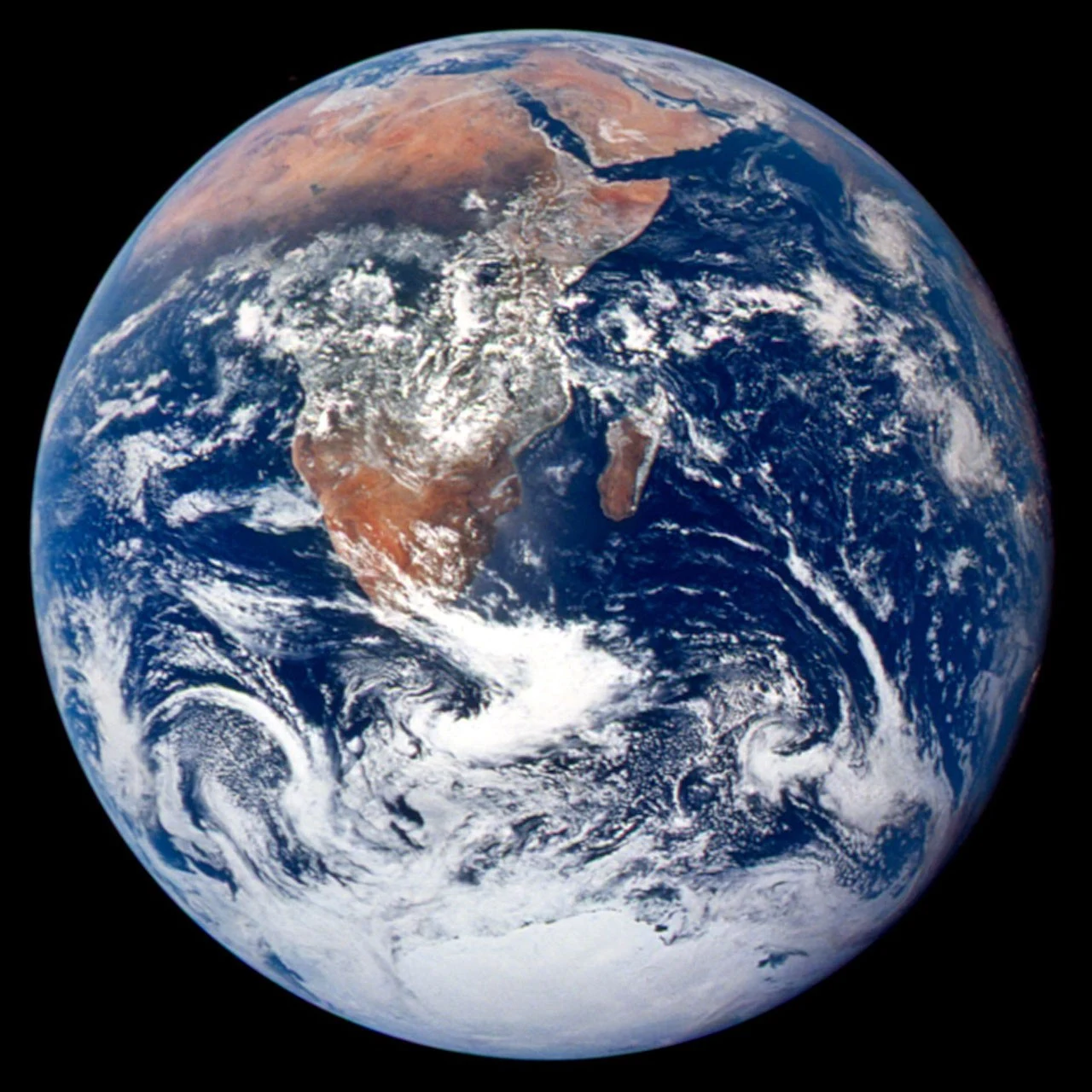
Start with the Blue Marble photograph used in this article. The Apollo 17 crew photographed Earth on 7 December 1972; the image credit is NASA Johnson Space Center. This is a historical photograph, not a picture taken during a 2026 event. Ask everyone to describe what they can see before reading the caption together.
Divide a sheet into three columns: “I see”, “I think” and “I want to check”. A white area can first be described simply as a white area. Calling it cloud or ice adds an interpretation. You do not need to know every answer immediately. The exercise helps distinguish an observation from an explanation and gives you a reason to consult the original image description.
Next, invent a mission on paper. Its task might be to produce an image of a chosen part of Earth. Draw the spacecraft and label what it would need to take the picture, store information and send back the result. This is a simplified model, so identify the questions you cannot yet solve. No real launch, heated materials or homemade propellant are involved.
Finish by making a mission card: a name, one research question, an expected result and a possible reason for failure. Compare the cards. If the spacecraft designs differ, ask whether that comes from different tasks or different assumptions. Explaining the choice of one component can lead to a more interesting conversation than adding extra decoration to the drawing.
How to read space news after the week ends
Choose one launch story and find the announcement from the organisation responsible for the mission. Start with its publication date. A preparation update and a report after launch can look remarkably similar in search results. Then underline the verbs. “Plans”, “launched”, “reached orbit” and “received data” describe different stages; they are not interchangeable ways to announce success.
Write three short notes: what happened, what is still expected and what the source does not say. If an exact cost or technical specification is missing, leave that field empty. A useful explanation does not need to fill every gap. Explicitly marking something as unconfirmed helps prevent a prediction from becoming an apparent result in your own retelling.
For a school project, add the primary-source link and the date you read it. Return later to see whether a new report has appeared. Keep the earlier note as well: comparing expectations with outcomes makes the process easier to understand than silently replacing the original account. It also gives a small project a clear next step.
Choose one activity for the next weekend
Pick one route: discussing a photograph at home, exploring the history of ESTCube-1, or arranging a visit to a science centre or observatory. You do not have to combine all three. Give the activity one tangible outcome, such as a question of your own, a mission card or a short explanation of something you have learned.
World Space Week 2026 ended on 10 October, but its theme remains a useful invitation to read space news more carefully. Save one unanswered question and decide where to look next. That way, interest can grow through a small investigation of your own as well as the excitement of the next launch.