Garden furniture: measure, maintain and store it
Outdoor furniture needs to fit the setting, walking space and winter storage available. A material name alone does not guarantee comfort.
Choose garden furniture by testing how it will be used, moved, cleaned and stored. A set can fit within a terrace’s outline and still make the space awkward once people pull out the chairs. Equally, a comfortable outdoor sofa can become an inconvenient purchase if its cushions have nowhere suitable to go when the weather changes.
Begin with the activity you want to support. Eating outside, reading alone and seating visiting friends place different demands on a table and chair. Decide which activity happens most often, then build around it. A smaller arrangement that is easy to use is often more valuable than a large matching set that spends most of its time obstructing the door.
Measure the space in use
Draw the terrace or balcony with doors, steps, railings and fixed objects. Mark the direction in which the door opens. Include planters and anything that must remain accessible, such as a storage cupboard. Measure the actual surface rather than estimating from the room behind it, because projecting walls and thresholds can change the usable shape.
Next, mark the proposed furniture footprint with removable tape or pieces of cardboard. Add the chairs in the position they occupy when someone is sitting down or standing up. Walk the route from the door to each place. Carry an empty tray to reveal turns that feel easy when your hands are free but become awkward while serving.
Do not use a single universal clearance as a substitute for this trial. The space needed depends on the chair, the people using it and whether others must pass behind. Test the arrangement with the household’s usual movements, including mobility aids where relevant. A layout is successful when people can use it comfortably, not merely when the furniture dimensions fit on paper.
For a small balcony, borrow the priorities in the small apartment layout guide: preserve access, choose the main use and avoid filling every available corner. Consider whether two good seats and a compact table serve you better than a larger dining set with chairs that cannot be moved freely.
Test the chair and table together
Sit in the actual chair if possible, wearing ordinary clothing and footwear. Check whether your feet have a comfortable position, whether the seat edge presses awkwardly and whether getting up feels manageable. A seat that suits a brief showroom trial may still be too deep for the way you plan to eat or work at a table.
Move the chair towards the proposed table. Check knee space, armrest clearance and the relationship between seat and tabletop height. Armrests that cannot slide underneath may leave the chair permanently further out than the dimensions suggest. Table legs or a central base can also reduce the number of comfortable positions around an otherwise generous top.
Try the arrangement for its intended activity. For dining, place a plate and glass or compare their dimensions with the usable surface. For reading, consider where a drink or book will go. A low lounge table can be convenient beside a sofa but awkward as a substitute for a dining table during a full meal.
Assess cushions as part of the seat rather than as optional decoration. Remove one and see whether the underlying chair remains useful. If comfort depends entirely on a large cushion, its handling and storage become essential parts of the purchase. Check ties, zips and covers while the item is available to inspect.
Ask what each material requires
Avoid choosing from broad labels such as “wood”, “metal” or “rattan effect” alone. Ask for the actual material and finish of the frame, tabletop, fixings and feet. Different components may need different care, and the visible woven surface does not tell you what supports it underneath.
For wooden furniture, obtain the manufacturer’s guidance on cleaning, finishing and acceptable weathering. Decide whether you are comfortable with the expected change in appearance and with any recommended maintenance. Do not assume that every outdoor wooden item should receive the same oil or coating; an unsuitable treatment can create another task instead of solving one.
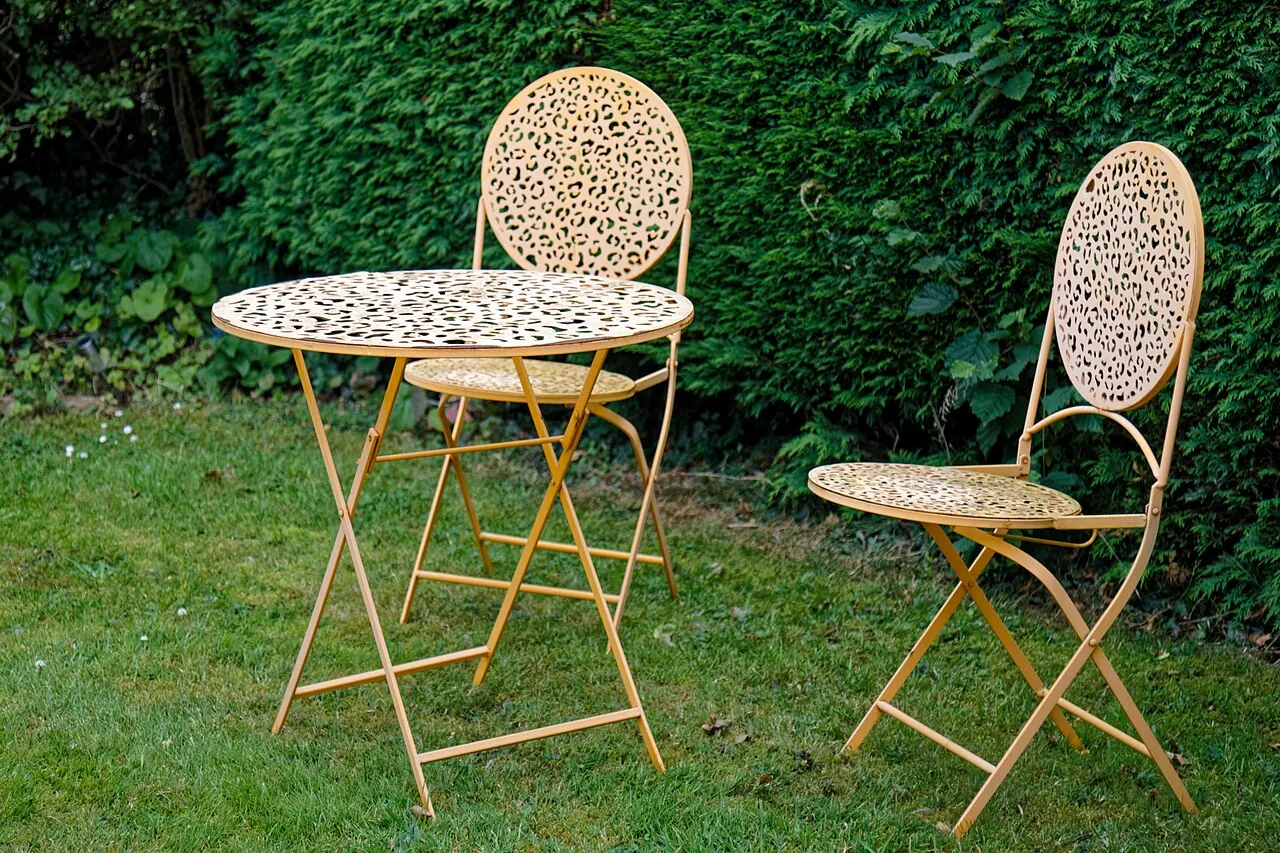
For metal furniture, inspect joints, coating condition and the contact points that touch the ground. Ask how damage should be repaired and whether replacement feet are available. For woven or plastic components, check the stated outdoor use and cleaning restrictions. The relevant question is whether this particular product suits your exposure and care routine.
If responsible sourcing is part of your choice, read the exact certification. FSC distinguishes its 100%, Recycled and Mix labels, which refer to different sources of forest-based material. Such a label addresses sourcing; it does not replace a check of comfort, weather suitability or the furniture’s maintenance instructions.
Look closely at the surface under the furniture
Check how the feet meet your actual terrace, decking or ground. A narrow foot may interact poorly with a gap between boards; an uneven surface can make a chair unstable even when it felt solid in the showroom. Compare the foot shape with the place where each leg will stand, and use only appropriate adjustment or protection recommended for the product and surface.
Try moving the chair without dragging it. Can one person handle it comfortably, or will rearranging the terrace require help? A light item is easier to carry but still needs an appropriate plan for exposed conditions. Ask how the manufacturer expects the furniture to be secured or put away during unsuitable weather.
For a balcony, do not infer structural capacity from the apparent strength of the furniture. Heavy tables, storage boxes, planters and people all belong to the overall arrangement. If the building’s limits or conditions are unclear, check the relevant building information before adding a substantial load or fixing anything to the structure.
Keep railings and access routes in mind when positioning furniture around children. Do not turn a seating arrangement into a convenient climbing route beside an edge. The design should support the way the space is actually used, including play and supervision, rather than assuming everyone will remain seated throughout the visit.
Make storage a measurable part of the purchase
Measure furniture in its folded, stacked or dismantled state, according to how it is designed to be stored. “Folding” does not necessarily mean small enough for your cupboard. Check the width of the door, the narrowest turn and the final storage footprint. A chair that fits inside a shed may still be difficult to get through its entrance.
Find out how many chairs may be stacked and whether protective parts are needed between them. Check that you can lift the stack safely and that it will remain stable in the intended place. Avoid inventing a storage method that puts weight on components not designed to carry it.
Choose a real home for cushions before buying. Count the complete set, including back cushions, and measure the pile without compressing it unrealistically. Check the manufacturer’s requirements for cleaning, drying and storage. A box is useful only if it can provide the conditions the contents need; its outdoor appearance is not proof of suitability.
If using a cover, verify fit, attachment and ventilation guidance for that combination. A cover is not automatically a substitute for sheltered storage. Include taking furniture in and out in your autumn garden plan so the task has a destination and sequence before bad weather makes it inconvenient.
Consider repair, delivery and assembly
Ask whether the parts most likely to need attention can be replaced: feet, covers, cushions, fittings or individual slats. Record the exact model and parts information. A product that can remain useful after one small component wears out may fit your needs better than a set whose only repair option is improvised.
Read the assembly instructions before accepting that assembly will be simple. Check the number of people required, the tools and the space needed to lay out parts. Confirm delivery package dimensions and the route to the outdoor area, especially where stairs or a narrow internal hallway are involved.
For second-hand furniture, inspect the underside and joints as carefully as the visible surfaces. Open folding mechanisms, check that locking parts are present and ask about repairs. An attractive finish can conceal a problem, while a superficial mark may be acceptable if the structure and intended use are sound. Do not use an uncertain item until its condition has been properly assessed.
Compare complete arrangements
Compare what you will actually bring home, including cushions, suitable storage and any required care products. Check the seller’s stated terms and what is included in the delivery. A photograph showing a parasol, extra chair or decorative accessories does not mean they belong to the offered set.
Leave space for the rest of the garden to work around the seating. A planting container should not block the route to the table or make watering difficult. If you want planting beside the terrace, the lavender growing guide can help assess that particular option without assuming every sunny-looking seating area is a suitable growing place.
Before making the final choice, repeat the physical layout trial with the exact shortlisted dimensions. Confirm that people can sit, move and open the door, and that the furniture has a practical winter destination. These checks turn a collection of attractive objects into an outdoor space that is straightforward to use throughout the season.